route

zondag 19 januari 2025

Cycling from Normandy to the Alps


After cycling from the 28th of November to the 19th of December, which is exactly three weeks, I finally arrived in Grenoble! Spanning a distance of more than 2200km and many vertical meters, I was especially struck by the many different landscapes encountered in Normandy, Bretagne, the Loire valley, the Poitou, Limousin, Massif Central and Alps. 
Descent to the Ecalgrain Bay
 amidst heavy rain and wind
The weather initially has been impeccably sunny which helped me tear myself away from the warm home of Guillaume and Alice. I explored the Norman Cotentin peninsula and Bretagne, which I was very curious for. I will point out a few highlights: the "Little Ireland" at the Westernmost point of the Cotentin peninsula. I passed there during my first rainy day of the whole travel (lets not count 10km in the rain to the Borlo Absthof at the start of my journey). It is a majestic piece of coastline, just grass and rocks and huge bays. The wind and rain quickly chased me back on the broad road inland but a descent to the bay next to La Hague was a sublime moment, because of the sheer size of everything. Huge waves crashing on a big beach hugged by enormous cliffs. The wind was so strong that I only slowly went down a very steep road. Incredible.
food, a dry place and a hot
chocolate: perfect for the soaked cyclist
I later on had my lunch in a cafe to warm up again with my soaked clothes and met two different elder men —besides the whole village it seems— who had sons who were avid bikepackers as well. I am glad to think that more and more people (even from a small village in Normandy) decide to travel this way as it reduces so much of our consumption habits. One of the sons is travelling to India from France currently, an incredible project. A typical situation that ensued in the cafe was that many people seemed to be intrigued by a heavy packed bicycle and when they saw the little Belgian flag on my mudguard, they immediately started to talk about 'la petite Belgique' and all the typical topics that come along with it, like the "Flanders vs Wallonia" situation and other elements of our overly complicated politics. I normally really don't mind going over all these topics: I like to bust some of the stubborn myths and give a more precise image of the country. Overall I think many bikepackers are always asked the same questions: where do you come from?, where are you going?, how long are you away? and so on. As a kind of an attention craver, I am proud enough of who I am and my projects to keep on enjoying these questions, without getting tired of them. For me these are often the small interactions, especially when travelling alone, that put a smile on my face. I only regret finding it difficult to switch the topic of the conversation to my interviewers, and asking them about their life. I sometimes have trouble letting my curiosity surface. It has become a certain insecurity over the past years, to ask less and not be driven by this longing for information, stories, lives, ... even though it is generally one of the primary drivers for travelling. Maybe I don't think about all the times when I actually do get curious, and I also can admit that I feel much more triggered by the world since I left on the bike. But on the other hand, talking about myself and my travel often reinforces this perceived lack of curiosity. I will probably follow up on this insecurity in another blog post.  
Mont-Saint-Michel, obligatory
 self-timer photograph here
At the end of the peninsula lies the ever-breathtaking Mont-Saint-Michel which I passed the next day in the morning under a beautiful pink sky. I slept in an excellent camping spot, in a little natural reserve with a view on the sea, amazing. That day I cycled to Rennes, knowing that I would get hosted by Wissam, who I found through Warmshowers. For those who don't know, it is a
 platform for bikepackers, that enables those who travel to get hosted by those who aren't. Joining costs a bit of money, but after that everything is for free. The community is huge in Europe and North America and especially in cities it is easy to find hosts. The few downsides are the fact that you often have to contact multiple people as they often aren't available in the end and that you have to contact them a few days in advance so they can prepare themselves for your stay, something that can be a bit tricky to calculate and can generate some deadline stress: you don't want to arrive a day too late. 
First puncture, not yet aware of the broken pump
This happend to me that day because I had two punctures (on each tire, so just some bad luck). When I had my first puncture I discovered that my bike pump was broken, which made it very difficult to inflate my tires again after gluing the patches on the inner tubes. I managed to inflate the first inner tube by holding the pump bits together, but the second time, in the afternoon, it somehow didn't work anymore. Luckily I had just arrived in a village and being too stubborn to ask, people helped me out when they saw that I was clearly not advancing on repairing my bike pump. Even the mayor helped me out! Having a functioning bike again, I was accompanied by bike one of my helpers, who was an avid e-biker. We talked about what a pity it was that cars are so central in the countryside and that no-one wants to use bicycles. After having split when reaching his house, I met road cyclist Olivier a few kilometers later and we cycled a bit together as well. We exchanged phone numbers and he sent me messages to encourage me ever since, an amazing thing to receive. It was incredibly energising to talk with other cyclists, especially since I met them so randomly. 
That way I arrived very happy and timely in Rennes and got hosted by Wissam in his small apartment. The shower felt amazing! Staying at Wissam's felt like being at home for a moment, even watching a movie together. Wissam is a super cool guy and incredibly welcoming. He was also super trustful and caring.
Wissam let me store the bike right in the middle of his tiny apartment
 and set up a little temporary wall in to provide some privacy: that's hospitality!
The next day brought some necessary bicycle maintenance, like swapping out the pedals and fixing my front bicycle rack in a better way to the front forks (screws tended to come loose). I also met up with a childhood friend, who lives and studies in the Breton Capital. Overal the city is very pleasant, with some modern well-sized neighbourhoods centered around an old medieval one. I cycled away in the late afternoon (sunset is round 17:00), thinking I'd find a good sleeping spot soon somewhere along the road, but weirdly I sensed a lot of energy to continue.
sleeping place of the night:
meditation yurt
I thus cycled a good three hours into the night to my next place of interest: the écolieux of La Guette, that was around 50km outside of Rennes, located in the mystical and mythical forest of Brocéliande. It got to know about its existence thanks to Els, wife of my godmother, who sent me this short 'Brut' documentary about it. It was my first ecological project I was about to visit without Nicolaas and I felt very uncertain, not knowing if there would be people or if I would be welcome. Having to base myself on satellite images and a vague description on a website to seek out the place that I had seen in the video, all my worries melted away immediately once I arrived. I stumbled upon one of the inhabitants, funnily enough called Nicolas, who without hesitation welcomed me. I was allowed to sleep in their meditation Yurt and offered a dinner. I learned that La Guette has a policy of absolute hospitality; everyone, no matter what, is welcome, as long as they respect the rules of the community. I stayed until the late afternoon of the next day. During that time I talked with the seven present inhabitants and learned more about the history of the place. Unfortunately, Alexis Robert, who is the creator of this "eco-lieux", was not present as his advanced age made it difficult to keep living in the harsh winter conditions of the quite rudimentary environment of La Guette. My late arrival in the dark made some of the inhabitants a bit hesitant to talk, but the next morning, I managed to have conversations with all of them.
Everywhere were this kind of signs
 that talked about certain topics,
 like here questioning the distribution of
 wealth of capitalist society
I learned a lot about the community, the experimental way of living and I also read their charter, a kind of constitution. La Guette is a place that is dedicated to peace and invites its inhabitants to try to experiment with values like living in harmony with nature, hospitality, learning about sustainability, togetherness, love and cooperation, soberness and healthiness in consumption, celebration of life, engagement, growth (of your own persona), ... I agree that most of these values seem obvious and you can even call a constitution about this a bit naive, but maybe the (re)creation of a society must start on simple principles like that, especially the harmony with nature, ultimately the most uniting concept of all life. It is true that some strict rules apply in La Guette, like no drugs, alcohol or screens (the three most addictive things of our society) and solely biological food. I felt that in the functioning of this place the purpose was also very much focused on spirituality. One of the inhabitants was for example a shaman (and yoga-teacher, fair enough). This also meant that La Guette had a strong accent on psychological healing through community-based life. Combined with the absolute hospitality, this meant that sometimes people with heavy and many (mental) difficulties would arrive and have a negative impact on the community. It shows a weakness of the idea openness, just like democracy often is vulnerable to undemocratic forces. It showed that even though an ideal seems nice, it can be very hard to actually maintain it. Another interesting example is that the lack of judgement and the value of freedom that was incapsulated in the proposed lifestyle made a lot of the community activity based on goodwill, which could succumb to apathy. Organisation was thus quite loose and frustrations existed about simple things like tidying up, cooking, dividing chores,... When does freedom go so far that it sabotages the good functioning of society?
My view from the Yurt, as you see,
quite rudimentary conditions
My day in La Guette was the 5th of december and I baked for the inhabitants the little gingerbread biscuits (kruidnoten) that are typical for the Saint Nicolas festivities that are celebrated that day in Belgium and the Netherlands (also because it was a birthday of one of the inhabitants). I fixed up some things of my gear and left at 16:30 or so, almost immediately cycling in the rain and then in the dark. I felt hazy and like my head was about to explode, so fully had I lived and acted there. I sensed that a few inhabitants really would have liked me to stay for a few more days, but I longed too much for the road and the route I had in mind, going all the way to the point of Brittany. After an hour of cycling the haziness (and rain too) went away and I again felt very energised like the day before, probably because I hadn't been cycling for a whole day. I even enjoyed cycling in the dark more, seeing a rather bland, open countryside sliding by, transformed in a mysterious landscape by the night, full of little lights, strange, huge agro-industrial buildings, with a road irregularly illuminated by passing cars. Looking out for a good camping spot, I was not finding any quickly on the Komoot map. That's when I stumbled on a camping car area in a village called La Chèze, where I found toilets, running water and even electricity. It was basically a sort of unintentional free campingsite for me, so I put up my tent, cooked a quite shitty dinner (tasteless couscous, I still remember the horrid taste) and sheltered my bike from eventual rain by stowing it in one of the toilets. I sang a few Saint Nicholas songs and put ready my shoe, like I had always done on that day of the year with my family.
Lunch on the side of the greenway,
and the necessary drying of the tent.
When I awoke the next morning, I found chocolate and a mandarine in there. Incredible that Sinterklaas (as we call the saint) had thought about me! (For those who don't know the tradition, it is a  gift-giving, white-bearded, christian precursor to the Santa Claus character). After this joyful event I cycled with good weather over an endless greenway that started in Loudeac, where I swapped out the worn-out brake pads on a handy free bicycle repair stand.  Especially beautiful was the lake of Guérledan and the gorges of the Blavet further upstream. I decided to approach the Crozon peninsula via a northward curve that would let me go through Huelgoat and the green area around Brennilis. I passed through Huelgoat and its mythical, beautiful forest in the late afternoon, but unfortunately by then the weather had turned from sun to dark clouds and the rain (literally and figuratively) dampend my curiosity for the many little beautifully carved canyons and rocks chaoses that exist around the city. I cycled out of Huelgoat, preparing myself for a rainy bivouac, when a car stopped a bit further up the road and a woman with children in the backseat asked me if I had a place to sleep that night. I said no and was promptly invited to stay in their house, following a small road after the nearest junction. Having arrived I slowly learned about my new hosts: Yann and Adé, and two sons. It was their eldest son, Thélo (cool name), who already saw me in the rain in town and wondered about how I would spend the night. He asked his mother when they saw me on the road to ask me. It is thanks to him that I owe this amazing night spent in 'Coat Guinec'. Apart from this rather atypical compassion for travellers, it turned out that this home was like a miniature La Guette, a place of experimental living, full of hope for a better world and the readiness to help others and build communities, including principles of hospitality. Yann and Adé are bakers, who cultivate as many of their own cereals as possible, a concept I already saw in Norman Switzerland called artisan-boulanger. They bake once a week and sell their bread on Friday in their little grocery store on their terrain, that also sells biological, local and bulk products.
picking up a loaf of fresh bread in
their grocery store the next morning
On Saturdays they go with their bread to different local markets. It seems incredible that they mostly manage to survive financially this way, although it clearly took a lot of effort to arrive in the situation they are in now. They for example build their own house, consisting of a wooden frame, isolated with straw and clay, that is the best isolation in many respects (only a bit vulnerable to moisture and rodents).  It was an incredibly cosy place and I felt happy for the two boys that they could grow up in this place. The rest of the terrain has a big vegetable garden and they also host another couple who lives in a Yurt (see the La Guette-vibes?). We ate soup that night with vegetables from their garden and bread from their oven, how beautiful I thought. I learned about their lives, what they dreamed of in the past, how they met and how they slowly rotated to their current lives. Yann is a travel and trekking passionate and was preparing for a three-month adventure in april, with no plan, just seeing where his nose would lead him to. We ended up comparing camping gear, very cool. I slept on their sofa, next to burning the wood stove and seeing their beautiful house. Peaceful. 
Brennilis lake, heathlands,
 right before a violent hailstorm
The next morning brought the same pleasant vibes and I talked with the boys who were up early. Leaving was again difficult and made me acutely aware how evidently I had felt at home here. But I carried my bags to my bike who had passed the night in the shed, picked a freshly baked loaf of bread I had bought from them and left, right into the storm Darragh that was raging in West-Europe and England then. I later learned that on this day, winds reached to speeds of 160km/h, many homes in Normandy and Brittany were cut off of electricity. I was soon to feel this powerful wind, but on my way to the Crozon peninsula (the middle peninsula at the Britton Finistère), I mostly saw the quickly chasing clouds, that brought short showers of rain and even hail. But I had the comforting, beautiful landscape of the Monts d'Arrée, with heathlands, oak forests and the huge lake of the Brennilis nuclear site to help me push through.
The more I approached the coast, the more I felt the wind. I luckily did not have to cycle entirely in the wind, but nonetheless I was slowed down a lot. I often checked the weather forecast to predict when new rainclouds would arrive. It enabled me to sit out quite a few of the raindclouds in the shelters that I encountered, especially my lunch turned out to be well-timed. I passed the impressive bridge Terenez bridge in the early afternoon and officially entered the Crozon peninsula; where I would face the strong winds even more. The landscape contained less of the bocage hedges at some places and it was incredible to feel the different powers of the wind at the different sections of the road because of this. I did get quite tired because of these gushes of wind that deviated my bike because they pulled on my front bags and thus my wheel. A part of me wanted already to turn around and go off the peninsula again, but I had seen the westernmost point of Crozon, Pointe de Toulinguet, as the target of my Breton journey, so I decided to cycle to the end, no matter what.
The point of the Crozon Peninsula,
 almost getting blown over by wind
I actually got rewarded for this, as I took a beautiful greenway, that was much more sheltered from the wind (by then, there wasn't that much rain anymore) and thus I arrived at the end of the land and witnessed an unchained sea and tormented skies. How powerful these elements felt! I also felt very proud that I had pushed through and had faced the winds. When cycling back to the Crozon village, the wind pushed this time me and made distances that took me hours to span in the other direction cycled in a mere half hour. A big mental idea now was that I was finally done cycling to the west and now every kilometer would bring me closer to Grenoble. That night I had to secure my tent with extra wires to hold it in place, because I underestimated the wind!
Westernmost point of my journey: Pointe de Toulinguet!
(Westernmost point of Brittany is Pointe de Corsen, more north)
Winding road to the Menez-Hom
The next day, when the storm was slowly fading away, I started my journey to Nantes and climbed firstly on the Menez-Hom, a "huge" mountain dominating the coast that is part of one the oldest mountain chains of the world, that used to be 4000m high and now barely reaches 300m because of ages of erosion by wind and rain. After reaching the top, anew fighting against a strong wind and fierce showers of rain, I thought about this inconceivable far away past. But only shortly because the wind almost blew me back from the top. Cycling back into the main land, I said goodbye to the sea and this time focused on the Black Mountains, that rewarded me, after a slow climb with beautiful views. 
View from the Black Mountains
I found more of the bocage and beautiful valleys, strangely sheltering some eucalyptus trees, quite unexpected. With my mind set on Nantes I advanced swiftly and cycled one hour into the night. I could admire the beautiful, flamboyant church of Kernascléden, illuminated in the dark and camped a bit further south. When continuing the next day, two of my spokes of my rear wheel broke off, prompting my decision to completely replace my rear wheel. I feared that after so many miles, many components would be so beaten that partly replacing the broken ones, would soon result in new failures. I looked for repair shops and found one in the nearby small city of Locminé, where a very flexible mechanic just gave me the parts so that my proud self could do all the repairs on my own. 
After having replaced chain, casette and the new wheel (and swapped out the rear tire to the front en put a new one on the back to prevent new punctures) I was ready to leave again, knowing that I wouldn't have any bike problems in the near future. I cycled again into the night and was already for quite a while listening to the whirring sound of my dynamo when a car that passed me by earlier on, came back and stopped. It was Anthony, called Doudou by close friends, who proposed to sleep at his place that was not far. That way I found myself again unexpectedly sleeping in a comfortable bed, with all these luxurious facilities like a shower and chairs to sit on. It soon turned out that Doudou was an excellent host and we shared two beers (one of them I bought in the bike shop of Locminé) while waiting for his wife to come back from the swimming pool. Doudou was incredible, also working in the field of building ecological houses from straw and clay (it really is a thing in Brittany and Normandy it seems), but suffered from his leg after falling down a rooftop on a construction site. He had sailed a lot and indeed gave off some captain-vibrations. I again felt at home very easily and enjoyed the conversation enormously. By then I was experiencing some minor physical issues, like a inflamed joint at my toe (called a tailors bunion) caused by slightly too small shoes and a strange reaction on the skin of my knees, ankles and knuckles. It became itchy and red and was probably caused by cold and dry weather. It would later peel like burned skin, but left no lasting effects (tell me if this is too much information).
I left the next day, burdened by a red kuri squash (a delicious chestnut-flavoured squash elegantly called potimaron in french) from their garden that would last me for days and really energised to cycle to Nantes. I was still hoping at that time that people of the Warmshowers community would host me in there, but I got no responses that day. The landscape around the very pittoresque village of Rochefort-en-Terre is very beautiful, full of heathlands, rocks and pine trees. A landscape that doesn't match the idea of typical northern French nature.
Then I approached the valley of the Loire, and the landscape became much more flat and less wild. I cycled with a firm idea of visiting the ZAD of Notre-Dame-des-Landes, nearby Nantes, the Zone à Defendre. I was told about it during my stay at L'impasse des Mages and I got fascinated by it ever since. The ZAD (that originally comes from the french bureaucratic term Zone d'Aménagement Differré, meaning an area with another special planned use) is the symbolic struggle between the city of Nantes and activists about a quite bocage landscape north of the city designated to become an airfield since the 70s. When the delayed plans finally became concrete in the 2010s it was deemed an Big Useless Project by many leftwing voices and the protest concretised by many activists all over France occupying the zone to prevent the construction, building instead temporary and permanent structures (similar to a squat) and quickly creating an anti-system, anti-capitalist and anti-autorithy society in this very concrete space. This has allowed experimentation with different types of alternative-progressive ideas, notably within the realm of agriculture. The stories about the ensuing struggle are very special, of the French government trying to evict thousands of activists with tanks and helicopters (operation César), tens of thousands participants building multiple structures in one day because of their sheer number (after César) and some of these activist still living there, for more than 10 years. It has become a symbolic case for many activists throughout the world and is also the birthplace for some of France's present-day most famous activist collectives, like the Soulevements de la Terre, that led the famous protests against the Mega-Bassines of 2022. To me the ZAD of Notre-Dame-des-Landes was an almost mythical place and one that was lying on my road to Grenoble. 
I made a horizontal traversée, which enabled me to see most of the area's of interest. Many little signs still show the past of the ZAD, like inscriptions on the road, statues, stickers, but it is mostly visible in the many buildings that exist there. It is clear that many of the new inhabitants are very active as shown by the artwork, gardens and fields that surround these improvised hamlets. Some of these structures where quite spectacular, like an enormous treehouse or a watchtower. Compared to the stories I heard and read, the place was actually very silent and calm. I only encountered a few people, who where difficult to approach.  Just like La Guette, the autumn calms down the very outdoor-oriented life of these ecolieux. I also realised that I was barging into people who had their everyday lives (and children) to take care of, which made me reluctant to just start asking question as this kind of "activism tourist". I cycled my way out of the ZAD, still impressed by the size of the place and the number of inhabitants and made for Nantes. Unsure if I would camp before the city or at the other side, I soon decided to cross it, even though the night had fallen. With a handy greenway I entered the city but soon lost track of the zigzagging indications and continued by phone. The contrast between the busy shopping streets and the ZAD could have not been greater, I was glad to cross the Loire river and leave the city behind me. 
In the now pacified ZAD, attention to new struggles always emerge
The next days led me into a very different landscape. First there where the extended and honestly depressing vineyards that produced the Muscadet wines, that slowly made way for new bocage landscape that still differed from the ones I had already encountered. Temperatures were dropping greatly, but the woollen gloves I had bought outside of Nantes fended off the cold. Ascending the hills of the Vendée near Pouzauges demonstrated very well how big and flat the Loire valley was and soon I entered more hilly areas.
Gate at the edge of the
medieval part of Parthenay
I passed through the small city of Parthenay, unremarkable on the map, but very beautiful and well preserved. Different churches, and old medieval neighbourhood, a citadel and old bridge are remarkable and impressive remnants of its medieval past. Definitely worth a visit if ever in the area. Poitiers on the contrary was, just like Nantes, reached on the wrong moment; early evening. I miscalculated how quickly I would advance and judged it too late to ask for Warmshowers. The cold weather even kept me on my bike so I superficially pedalled through the city center and bivouacked 15km south of it. The next two days would bring me into the Massif Central, ultimately to Clermont-Ferrand. Conditions were more misty and rainy even, but an afternoon of sunshine kept my spirits high. I also encountered a lovely lady one morning who had a biological foodstore in a small village. She had the habit of talking a lot with the clients and even slipped an encouraging note in the bar of blueberry chocolate that I bought.
The Massif Central, and more specifically the Limousin region where I biked, once again had its portion of bocages, that I kept on enjoying and had the first real mountainous relief that I encountered on this journey. This meant long climbs and long (but always over too quickly) descends. What especially impressed me was how little villages and houses there were and the size and extent of forests. 
Sunset and snow while
climbing the Chaîne des Puys
Unfortunately the mist refrained me from enjoying the views, but certainly made the trip more mysterious. The last day before Clermont-Ferrand was better, with the spectacular landscape of the snowy Chaîne des Puys appearing on the horizon. I encountered that way my first snow when crossing that ancient (dormant) volcano range, right under the very remarkable Puy du Dôme (the highest volcano, that also dominates Clermont). After a descend in the dark with the beautiful lights of the city getting closer I finally arrived at the place of Laure and Stéphane, old friends of my fathers. I was received very well after a long day and we talked a lot (old stories about their adventures with my dad). When planning my stay, there was the option to visit them in their chalet up in the mountains during the week. As I had arrived on a sunday, the plan was to cycle the next day to that very chalet. Sleeping again in a good bed, after an amazing shower, I took the opportunity the next morning to walk around the city and visit the two beautiful churches. 
The afternoon saw the climb to Picherande, where the chalet was. It was a steep ascend, but above, where the snow was abundant and under a setting sun, it was really worth it. Two nights well fed and well slept prepared me for the last stretch to Grenoble. I left the next morning during blissful weather, with a warm wind from the south that seemed difficult to match with the snowy landscape. I took time to clean my chain once again and descended back to the valley of the Allier through one of the most beautiful valleys I have seen. Sleeping on the other side, in the Livradois mountains, with a view on the Chaine des Puys was like closing the loop. Now all that mattered was arriving in Grenoble and cycling beautiful routes to it. This brought me along the very imposing church of La Chaise Dieu, where pope Clement VI is buried, through the Loire valley (where the river is just a little baby-version of the one I crossed in Nantes) and then into the northern part of the Ardeche, where I again cycled through snowy landscapes and steep valleys. 
Warm weather on the snowy Puys, necessary maintenance,
mysterious castle ruines down the valley and a toddler-version of the Loire 
There I to make a choice: advancing as far as possible to make the last leg to Grenoble shorter, or stopping before dark to not miss any details of the landscape. I decided to continue after dark, and I did not see a thing from a really long descent in a huge valley, probably full of amazing views. I still feel like that was really a pity. But it was the right choice, because my final day was really long, 165km and quite a few altimeters. Weather had worsened again and the whole morning was quit drizzly, with a short sunny break around noon.
Canyon of the Doux river in the Ardèche
I left the beautiful Massif central through a last spectacular canyon and then had to cross the ugly, empty, industrial Rhone valley. As a kind of finale ride, I had set my mind on reaching Grenoble through the Vercors massive, which implied a last big climb (whereas I could have simply followed the Isère river). What especially attracted me where the incredible canyons made by the Bourme river, where the road is completely cut into the mountain. But when I entered the massif, rain came back and did not quit anymore. I didn't stop me from enjoying the views but I became worried about snow on higher altitudes and descending with wet clothes. It was still raining when I finally arrived on the snowy plateau, but during my short break where I tried to prepare myself for an ice-cold plunge back to Grenoble, someone warned me about an impending snowstorm. Five minutes later the rain had become snow-flakes, so I knew I had to move quick. Frantically cycling towards the end of the plateau, I felt my hands and feet go numb from cold, especially the feet. The water that my front wheel splattered up towards the chain guard, instantly froze to it, making huge blocks of ice hanging from my bike! It was very intense, but once I started to descend, the snow became rain again and I somehow made it down all the way to the valley bed. I remember being afraid of loosing control over the bike with the numb fingers, but everything worked well, and I was very careful in the rainy dark. During the last stretch through Grenoble my woollen gloves managed to warm up my hands again and in spite of a wrong turn, I managed to arrive safe and sound at my grandparents place. 
Last, but beautiful picture of the journey to Grenoble (before I became tired
and the rain heavy): the suspended houses of Pont-en-Royans at the foot of the Alps


Post-Scriptum: the next weeks I spend in Grenoble, celebrating christmas with my family. I planned leaving even before the end of the year, but for different reasons I procrastinated my departure several times, the main reason I simply could. I enjoyed my time with my grandparents. I also procrastinated this blog so much that it became tough to work on it there. I have now left again towards Madrid, and I find more structure to write again! I will try to more quickly catch up with my current travels...

woensdag 11 december 2024

Thoughts about the things I carry


It's been almost two weeks back on the bike and I'm very content. I've been cycling more than 30 days and been from home for more than two months. As promised in October, I wanted to review some of the gear I'm carrying along. It might be useful for some of the readers if they ever wanted to go on their own bicycle journey and others may just be curious. I see myself as a bit of a gear fanatic, having spent a lot of time browsing the internet for different objects. Especially the camping stoves proved to be a loooong rabbit hole for me. In general I love to talk about gear and share my very young wisdom about it. A warning: I have to admit that a lot of gear is from Decathlon. I know it has many haters and I also disprove of the portrayal of outdoor sports as a means of mass consumption, but on the other hand, some gear is so well designed and cheap that it is hard to resist. I read often that Decathlon gear has an invincible price/quality ratio and I really have to agree with them. I decided recently that I will start buying more gear from Patagonia, because the company has converted to a profit-for-the-planet business. Of course secondhand material is the best solution to my dilemma of not wanting to consume, but still needing some gear. I lastly realise that I probably carry too much as well, but I prefer to be prepared for too many scenarios than too little. I bike by the philosophy of doing a lot of kilometers, but not being in a race, so some "unnecessary weight" is allowed.

The bike
My bicycle as it was before leaving. Notice the horns on the handlebars, the front rack, leather saddle and disc brakes
Let's start with my most important tool: my bicycle. It is a Velo de Ville L200 sport I got as a birthday present in 2020. Its price was around 800€, but since the Covid crisis bicycle and their parts got more expensive. I actually don't really recommend this bike. Quite soon, in the summer of 2020, I experienced some serious issues, like a broken bicycle stand and even worse: a completely destroyed bottom bracket (which is one of the most durable moving parts on a bike). Both got replaced, but the latter one necessitated a ride with a tow truck (the guy really laughed at me calling him for a broken bike) to the nearest workshop, in this case a decathlon. The next summer another weird thing happend: my front wheel with dynamo got completely stuck on itself in Italy, so I also replaced the whole front wheel, luckily with a secondhand disc (cheaper), but without a dynamo; I still remember the very nice Italian mechanic. I did already cover more than 10 000km before that, but it still feels like it was a bad quality wheel after all. My rack on the back also cracked (hey that rhymes!), around that time, but I fixed it with a little zip tie. So, some things broke on it that shouldn't have, and too soon to call it normal wear and tear in my opinion. On the other hand, I took it on a sufficient amount of trips to have all the faulty parts replaced, so currently it is a pretty good bike. The two specs I want to mention are first the Shimano Deore 3x9 speed system, which makes it perfect for almost all climbs. It offers good shifting performance and very precise gear settings. A downside is the fact that the parts are not that common and more expensive. 
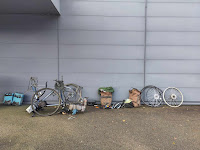
Big maintenance after 2500km: new
 tire, chain, sprocket, disc and rear wheel
That is why I was carrying a spare chain and sprocket, to not waste time finding a mechanic when it was time to replace the parts. A few days ago it finally was time to replace everything, so I was happy that I had carried them along.  I now should be good for at least the coming 2000km, so I'll wait a while before looking for new spare parts. I'm curious to test out the rule that every time you replace the chain, you should replace the sprocket as well and see if one sprocket can outlive two chains. Coming back to the gear shifting systems,  I now think that especially the Pinion system in combination with a belt-drive, is far superior in terms of shifting and durability. It comes with a huge price (around 4000€) and the downside of when breaking down is really getting stuck as they are not easily replaceable.
Secondly the Shimano hydraulic disc brakes. Even though I think that a classic v-brake system is a bit more practical, repairable and cheaper when bikepacking, I really love my hydraulic disc brakes. I only swapped my braking pads twice, just recently in Bretagne and they are very reliable. I know that when I'll have a problem (like a leakage, cracked cable, damaged pump,...) I'll have to go to the nearest shop, but as these become more common thanks to the e-bikes it should be easy to get it fixed.
Other mentionable things are for example the front racks, that I permanently borrowed (or did I end up paying for them? I don't remember) from a friend's old Koga Myata. It fitted well on my broad front forks and they are doing their job, even though sometimes one of the screws tends to get loose, a thing I had to go to a bike shop for in Rennes recently. My saddle is presumably a vintage leather Brooks saddle (probably a B17, but without holes), I bought secondhand for 10€, an incredible steal! It is very comfortable, but it's showing cracks near the sides. I've no idea how much it will last,  but I try to take good care of it with leather grease.  I bike without padding, as I found I got saddle sores even with them and I prefer a good pair of pants or shorts with pockets that is easily washable, dries quickly and doesn't make you look like an idiot (my apologies to the many bikers who wear them). The saddle doesn't chase my bottom pains away, but it feels good to sit on, which is the main reason I don't replace it.
I prefered to use my pre-installed front and back lights, but didn't want to invest in a new hub dynamo so I chose something very unpopular in the bikepacking community: a bottle dynamo, one of those old things that run on the side of your tire. I mounted it with some scraps of metal to my fork and so far I've been very happy about it. It slows you down a little (although the resistance becomes quite insignificant at around 15km/h or so), but the luxury of only generating energy when wanted and not having to stop to mount battery-powered lights —that (dammit!) you probably forgot to charge the other day— is very underrated. Only drawback is probably the noise, that for some could be irritating, but I don't mind at all. I can recommend this solution if every your hub dynamo dies on you.
Other modifications are little horns I mounted on my handlebars to have different hand positions. In the past, I got painful hands after a while from always carrying a part of my weight on the same area's of my hands. A first solution were special bicycle gloves (that tend to stink terribly after a while), but since I installed these horns, I never got any pains again. A butterfly handlebar is probably an even better idea, but more laborious to install and I didn't manage to get my hands on one. These horns are anyways sufficient for me! 
A last experiment I did was modifying my chain guard. I always get frustrated by a clean chain that then gets splashed with for example dirty water when riding through a puddle, so installed an old second chain guard flipped over the first one to better protect my front gears and chain. They still get dirty, but a bit slower is my belief, so it's not a necessary modification, but does not harm either. I think it looks quite cool, as a little inconspicuous detail as can be seen on the left here.


Tools


Coming from the bicycle another thing I suspect some readers might be interested in is which repair tools I carry with me. I will clarify some tools that might not be clear in the picture here above. From top left on, I have a rag and grease that I use for the saddle and for my shoes. It helps the last-named to fend off drops and the morning dew, but they will of course get wet in the rain. The three wrenches, of 8mm, 10mm and 15mm are the only ones you normally need on a bike (sometimes a 12, 13 or 14 is needed for the saddle or seat tube). They are complemented by the adjustable wrench. The rear sprocket key (next to degreaser can) is used in combination with the chainwip (self-made from wood and old chain, next to adjustable wrench) to dismount the sprocket. The degreaser is a very good bio-based one from Decathlon. It is itself quite fatty, but gets easily washed away with water taking most of the dirt away. I apply it with the toothbrush so to immediately remove the worst dirt particles off the chain. The grease in the tube is mostly for ball bearings, but I also use it as mounting paste for screws, so to prevent them from rusting or locking. The crank puller (next to the tube) is not super important, but it doesn't take up much space and can be useful when I want to replace a broke crank or clean the front gears. Under the tube is my chain opener. This is of course necessary when replacing a chain. Although with quick-links you could also use the specialised set of pliers, that I don't have, I think a chain opener is more versatile. I carry no spare inner tube, as most of the time the flat tires come from a sharp object. Then only a inner tube patch is needed to cover up the hole, which takes up way less space and costs much less. Another tool I appreciate a lot is the chain wear measurer, next to my screwdriver set. It can show if the chain is worn for 50, 75 or 100% and indicates thus exactly when to replace it, preventing excessive wear on the front and rear sprocket. Also, gloves might seem like a luxury, but often having little water at my disposal or having to look for another thing in my bags, I am very grateful for keeping my hands relatively clean. The tape, sand paper and zip ties are general tools I often end up applying on different things, they weigh a little and should be taken along in any case. The little fastening pincers are also quite general in their use, but I discovered that they are an excellent tool to accurately measure the wobble of the wheel rim, when truing a wheel. Very handy! Something not shown in the picture, but of course indispensable is a little bike pump!

Bicycle bags

Handle bar configuration:
Front pannier, tube bag and grey
 bag containing
my camping mattress (see below)
I carry most of my stuff in four Ortlieb bags. The two light brown ones are more than 10 years old! Ortlieb really lives up to its name of durability, and  even though other brands make decent bags as well (Decathlon, Vaude), I think my experiences show that Ortlieb really is the brand to go for. The old ones are kind of loosing their waterproofness, and that's why I put that orange raincover over them, even though I have remarked that some water also gets in from the underside, but so far nothing I really worry about. The little blue bags are brand new, bought them secondhand from a lady that didn't like the colours, for half the price. A huge steal! Combined with these bags, I have an Ortlieb front pannier that hangs on my handlebars that contains item I want quick acces too, like beanie, gloves, sunglasses,... this bag is completely water-proof and super handy with a magnetic closing mechanism. It is really an upgrade to consider if ever bikepacking. It even has a see through part, where you could put a map or phone to guide the way. I used it when entering Paris and having to follow the gps closely. A little handy decathlon back is hanging on my upper frame tube and around steering pen, it contains more items that have to be ready at hand, like multitool, pump and cutlery. Lastly I have a little saddle bag, that contains the orange raincover and a bag that I cover my leather saddle with when it's raining and I'm not sitting on it.

Cooking system (rabbit hole warning!)


After initially going on adventures with a gas stove and for a long travel experimenting with a petroleum (multifuel) stove, I became interested in alcohol stoves. I dislike gas stoves as they function on an expensive, fossil fuel, that also has this very bulky gas cans, that apparently are hard to recycle and cannot just be thrown away in the general trash or metal recycling bin. Multifuel stoves are very efficient (it vaporizes the fuel before burning it, so the flame is very clean), but I was disappointed to learn that the only fuels that don't damage the system are white gas (very pure but very expensive and hard to get by) and petroleum, something that is a bit expensive and also sometimes not widely available. It is nice that in emergency you can use the stove with gasoline or diesel, but I don't feel comfortable with it, as gasoline literally corrodes your plastic and aluminum parts and diesel tends to clog the tubes. Let's also not forget that all of these are fossil fuels with serious environmental hazards. It made me turn to burning alcohol as a fuel source. It is often made of organic waste from other industries and thus is quite renewable. The general downsides here are that it has a less high density in calories, so it cooks slower using up a bigger volume of fuel. This is not really a problem unless you're in a hurry. I don't mind; I like to do other things like setting or folding up the tent while the stove is cooking water.  The same goes for the volume, which is not bothersome while bikepacking. I even tend to pick up a 500ml soda bottle from the side of the road to get rid of the 1l bottle when it is half empty. Another problem is that is burns quite soothy, but I found out that it depends on the brand of alcohol and also how close the pan is to the flame (which reduces the sooth, somehow). Alcohol also becomes harder to ignite in colder temperatures, but there is nothing that a good lighter or matches can't do. I also think of the problem of having to pour the alcohol in the burner, so you can only estimate how much you need. I became quite good at assessing that amount, plus if you overshoot in the evening you can snuff out the flame and burn the rest in the morning if you cover up the burner. If during cooking you fall short on alcohol, you simply refill and ignite again of course. So most of the downsides are not really big problems that in my opinion don't add up to the versatility, sturdiness (no moving parts!) and cheapness of an alcohol stove. A secret plus side is that you can use that alcohol as a disinfectant, for example after you have gone to the toilet.
I tried to cook with a self made one (look up "soda can stove"), but was not satisfied with how fragile it was and the lack of good windscreen or system to hold up pans. I found a Trangia cooking system secondhand in 2023 and immediately fell in love with it. It is a brand originally developed by the Swedish army to provide it's soldiers with warm dishes even in harsh Scandinavian winter, which I think is a cool history! The very efficient windscreen that also house two pans and can even fit the tea pot (which I found in our basement funnily enough) or an extra pan, is a very cool design (very minimalist as well!). It also holds the pots really close to the flame, so I actually don't get a mess. I also like the cutting-board/strainer system. All to say is that after a couple of years of searching and experimenting, I will rarely use another system again.

General tools


A quick word about my most important "general" tools. The most important one is my Leatherman multitool. It contains besides that superb set of pliers, different screwdrivers, a saw, file, awl (to make holes) and two blades. I use it in very different scenario's and I like the sturdy build. Leatherman also offers a lifetime warranty, which is nice. I actually contacted them a few years ago, having a piece broken off on the Leatherman my mom had. They immediately offered to replace the tool with a refurbished one (the one I carry right now), just to say that they live by their promises. My foldable cutlery (brand is Sigg, but there are many) is also very handy, especially the knife and the spoon that I use for every meal. They are very minimal and easy to clean, so I expect them to last a lifetime. Last but not least is the little Victorinox SD, which although is meant as a manicure tool, has a super useful pair of scissors and a very handy little knife. I can really recommend having such a thing on your chainring. 
Planning my route down the Cotentin
peninsula and the map in the etui
Also an important tool is clearly my map etui, which holds my Michelin maps. Waterproof and handily hanging across my shoulder it enables me to always know where I am and where to go. I can clearly recommend navigating this way, as the maps shows points of interest. This and the ability to generally overview a broad area gives a lot of flexibility. I often only decide how to ride in the morning or even at a junction and even then can adapt. Compared to mindlessly following the suggestions of an algorithm (and not deciding for yourself what you want to see) or planning everything up front, it is a very relaxed system.

Camping equipment

I chose as my sleeping bag the "Makalu Light 3 down". It is from the Decathlon Simond brand and costs 300€. For a winter sleeping bag that has a comfoirt temperature at -10°C that is a very low price. So far it has been too warm to sleep in it with the zipper fully closed, so it's very promising for the colder temperatures of the coming months. I might invest in a more expensive sleeping bag in the future, but so far I'm really happy with it. The only problem with winter sleeping bags is that they are so bulky and a bit more fragile. It takes up more than half of one of my rear bike bags, and I am constantly worried I might compact the down too much, it is next to my bicycle the piece of equipment that I stress the most about. Accompanied is a small liner bag of polyester (not silk), I use it mainly as a way to keep the sleeping bag clean. Together with the sleeping pad it is also a Decathlon product. I have the insulated foldable pad from Decathlon because I was tired of every inflatable pad eventually becoming punctured after a not even a year of use. I prefer the lower comfort of a sleeping pad to waking up in the middle of the night, feeling the ground completely underneath you through the deflated mattress. I solved the bulkiness of the foam pad by hanging it from my handlebars protected in a custom made bag (merci maman! :))
The new tent!
I have always used tents made by Quecha/Forclaz (Decathlon). With Nicolaas I started out with their tunnel trekking tent. It is a very durable model, the one I had has been used since 2018 and is holding out just fine! As we split up in L'impasse du Mage, he returned with that tent and I bought the dome tent from the same Decathlon series from Guillaume. So far i'm really happy with it. It offers much more space, both for the luggage, since it has two storage rooms and offers room inside for myself to sit up in. It is a bit more long to set up and break down and packs less easily, but I find that the comfort is really worth it. I also think that, even though it is a few hundred grams heavier than the tunnel tent, it is more versatile. Since the outer shell can be separately packed easily from the inner tent, it can be shared between people when for example hiking. Another huge upside is that it can stand on itself, and doesn't need the tension from pickets. The design of some details is also nice, with the zip taking the outer flap along when opening up, so that you don't have to deal with a wet sheet that hangs in the way when getting out in the morning. Also a few hooks in the ceiling, enable you to dry a few things during the night. Lastly I also brought a tarp (from Decathlon), that I use to cover my bike with when the night is rainy (as too much rain is not good for a bicycle). It is a very versatile piece of equipment, I can use it to create a temporary shield against rain, for example when cooking or eating or in case of very heavy rain to protect my tent itself. It can even serve as a back-up tent in case of emergency.

Electronics

I don't carry that many electronic items right now, but I know that they can add up quickly. I have a headlight,  an e-reader being a secondhand bought Kindle, my smartphone (a Fairphone 4, please check out this amazing brand) and my laptop (macbook air). I also took little cabled earphones, with a usb-c connecting dongle. To charge everything up, I took two powerbanks with me. And old one from decathlon that used to have a capacity of 10 000 mAh and a secondhand bought Anker of 20 000 mAh, that is still very powerful. They so far give me at least autonomy for a week, but I probably could hold out longer if I didn't use my phone to record my routes and as a hotspot for my laptop. The latter can actually also serve as a back-up powerbank. I used to take solar panels with me, or dreamt to install a dynamo powered charging system on my bike, but I realised that it's rarely really useful. It's much cheaper and simpeler to just ask people on the way or stop in bars to charge up. Only in very remote places and with a lot of devices like drones and cameras does it seem useful to me

Clothing

A lof of clothes I carry are pretty straightforward, like socks, t-shirts and underwear. I have enough of them to hold out for a few days at least. I bike with one pair of pants, that I until now have carried like shorts; it's one of those trekking pants with legs that can be removed with a zipper. It's a decathlon model and I like it because it is light and dries really quickly, yet at the same time is super sturdy. I feel that pants like this don't have to be washed often, as long as you change the underwear enough. I have a set of thermic clothing, consisting of a turtleneck and tight pants in a very smooth fabric. I mostly wear the turtleneck now together with my blue fleece sweater. They work really well together to keep me warm in this cold weather and at the same time remove excess heat from efforts (like climbing a hill). When stopping I often put on my last layer, consisting of my shell jacket of Patagonia '(Torrentshell), that I bought in Paris. It also is my protection against rain and strong wind. After one month it still holds up pretty well, but I should wash it soon to restore all its water-resistant properties. I like the simplicity and lightness of the jacket. A luxury I allowed myself to take along is a pair of what I call "civilian" clothes, consisting of a normal pair of pants and a comfy woollen sweater, that I can carry when not cycling, for example when exploring a city or staying at a place. It also sooo nice to put them on after a shower when getting hosted in a house, it just feels more cosy than putting back on the cycling clothes. They take up quite a lof of volume, but they proved to be very useful, especially when staying for three weeks in L'impasse du Mage and giving the opportunity to change clothes enough.
I have low-cut hiking shoes (from decathlon), that are quite comfy and sturdy. They don't dry as quickly as I want to, but they also take a longer time to get completely soaked in the rain. I have flat feet, so it is nice to have good shoes I can put my orthopaedic soles in. In general I feel that shoes are not that important and that you can bikepack with any shoes you like, as long as they are comfortable for you.
For cold weather I took along a beanie (that fits under my helmet), a buff (perfect for cycling), and two layers of gloves. My silk undergloves have worked really well up till now, just fending of the wind, as to keep my hands warm. But in the last days, temperatures have dropped even further, soon will be the first sub-zero night, and it is time for the big gloves (that were special Shimano Gore-Tex cycling gloves). Unfortunately I managed to loose one of them in the last days, but at the same time they were a bit too small for me (I have no idea why I didn't notice when packing). I thus bought good woollen ones in... yes, a Decathlon. They are really nice and will probably take me through the biggest colds, especially if used together with the undergloves, ... as long as I don't loose them of course. I have also little cycling gloves for when my hands get painful, but so far I almost didn't wear them. Last items on the list are a visibility jacket, a pair of swimming trunks, a trekking towel (one of those that dries quickly) and last but not least a helmet. I want to stress that piece of equipment, because I've seen so many bikepackers without helmets and even though I understand the amazing feeling of the wind in your hair, unconstricted by that polystyrene box, it is so vital for your safety. I admit that when commuting in town, I don't wear one. I should, but then a helmet is not practical for when stopping and having to carry it along and also there is this sensitive question of pride and vanity of not wanting to look like a fool (not helped by the fact that very little people in Belgium carry helmets in town). But out on the roads, your time on a bike increases dramatically and also your chances of falling or having an accident. It can happen in many scenarios, like Nicolaas who fell in the Ardennes because of a slippery wet stretch of downhill tarmac. That's when a helmet is crucial and life-saving. When working as a cargo bike courier in Antwerp, I fell once in similar conditions, landed on my back and smacked with the back of my head on the ground. Luckily I was wearing a helmet and didn't hurt myself. But I felt the violence of the impact and I don't want to imagine what it would have been without that protection. I can add that a helmet offers also a few plus sides. It works really well to keep rain out of your vision and also gives shade against bright sunlight. I put some extra high-visibility tape on it, so I am even more safe at night.

Miscellaneous

Different not very connected pieces of gear that I want to review quickly are a thermos bottle that I fill in the morning and make tea in at noon. Drinking something something warm in cold weather is very good for the digestion of food, an Alpine guide once told me. I have also a big camelback-style water container of 5 liters; not useful in France, but it's good to have it in case of emergency or when cycling in drier places like Turkey or Morocco. In tandem with it I brought a water filter, that I so far haven't used, but might be soon. I also have a special gadget consisting of a rubber mesh with metal parts that can be put under the shoe, and which enhances grip on ice and snow. I imagined myself having to push the bike up a snowy and icy hill and took it along (it was a birthday present from a while ago). It's probably one of the least useful, but bulky things I carry. I'll see if I keep them or not after Christmas. 
I further took along —naturally— a medical kit, which contains many different things, like different medicines, bandages, disinfectant and even a handy little sowing kit. 
Also a quick word about toothbrushes and toothpaste. It's more a call to stop wasting plastics than really a primordial thing for when trekking. I have one of those toothbrushes where only a small head needs to be replaced and where the handle is continually used. During an earlier trek half of the handle broke off, but I simply connected half of a bamboo toothbrush handle with a screw onto it, and now I have probably one of the coolest toothbrushes out there. I find extra heads in waste- and package-free shops in larger cities. The toothpaste is also very interesting: I have "Dent tabs" with me, that are small pills of toothpaste that just begin foaming like the regular one if chewed on a little. They are often bought in bulk in the same kind of shops, and even a handful can last you for weeks and weeks, as they are very small. They contain fluoride, so it's as healthy for your teeth as the regular brands. As with many products, a lot of brands sell you partly just water, and denttabs are a nice way of circumventing that rip-off, tackling a big problem of plastic tubes along the way. When on a short trek you can even count how many pills you should take along and reduce weight and volume to a minimum! I've been using them every day for a few years now and it feels as natural as any other thing of my daily routine.
Another thing I would like to mention about hygiene is that for more than one and half years I have stopped using shampoo or soap to wash myself. I simply rinse myself off with (preferably) warm water. I scrub a little extra on the parts that accumulate more sweat, like armpits, arms or pubic area and I take time to massage my hairs well, and so far I've been doing just fine. I received no complaints of smelliness (what I was most afraid of) and no special skin disease has appeared. My hair is a bit more fatty than when washing it regularly with shampoo, but it is actually hard to notice. I have some periods with dandruff, but that happend in my "shampoo-life" too. The reason I decided to stop with this products is first of all the realisation that many shampoos and shower gels are not very good for environment and climate. Even though more nature-friendly alternatives exist, the fact that I don't really need them, made me persevere. I also feel now (and this is not really backed up by science whatsoever) that my skin and skin bacteria are good at regulating themselves and I don't need to remove them with soap every time I wash myself. Now when trekking and only having the opportunity to wash once in a while, I consider this decision as a huge win: I don't really feel that dirty, compared to a few years ago when I stopped every night in a camping to be able to take a shower. A drawback to this, is that in general I avoid swimming pools whose water contains chlorine. It is essentially the same as any soapy product and after a splash last year, I could feel how my hair was completely dry again. You need to go though a period of quite greasy hair when stopping with shampoo and I had to go through that phase again after the visit to that swimming pool. In general I don't judge people at all for using soap and shampoo, maybe I'm just lucky with a body that is regulating itself well, but I hope I've managed to inspire a few to just test it out for themselves...