route

woensdag 11 december 2024

Thoughts about the things I carry


It's been almost two weeks back on the bike and I'm very content. I've been cycling more than 30 days and been from home for more than two months. As promised in October, I wanted to review some of the gear I'm carrying along. It might be useful for some of the readers if they ever wanted to go on their own bicycle journey and others may just be curious. I see myself as a bit of a gear fanatic, having spent a lot of time browsing the internet for different objects. Especially the camping stoves proved to be a loooong rabbit hole for me. In general I love to talk about gear and share my very young wisdom about it. A warning: I have to admit that a lot of gear is from Decathlon. I know it has many haters and I also disprove of the portrayal of outdoor sports as a means of mass consumption, but on the other hand, some gear is so well designed and cheap that it is hard to resist. I read often that Decathlon gear has an invincible price/quality ratio and I really have to agree with them. I decided recently that I will start buying more gear from Patagonia, because the company has converted to a profit-for-the-planet business. Of course secondhand material is the best solution to my dilemma of not wanting to consume, but still needing some gear. I lastly realise that I probably carry too much as well, but I prefer to be prepared for too many scenarios than too little. I bike by the philosophy of doing a lot of kilometers, but not being in a race, so some "unnecessary weight" is allowed.

The bike
My bicycle as it was before leaving. Notice the horns on the handlebars, the front rack, leather saddle and disc brakes
Let's start with my most important tool: my bicycle. It is a Velo de Ville L200 sport I got as a birthday present in 2020. Its price was around 800€, but since the Covid crisis bicycle and their parts got more expensive. I actually don't really recommend this bike. Quite soon, in the summer of 2020, I experienced some serious issues, like a broken bicycle stand and even worse: a completely destroyed bottom bracket (which is one of the most durable moving parts on a bike). Both got replaced, but the latter one necessitated a ride with a tow truck (the guy really laughed at me calling him for a broken bike) to the nearest workshop, in this case a decathlon. The next summer another weird thing happend: my front wheel with dynamo got completely stuck on itself in Italy, so I also replaced the whole front wheel, luckily with a secondhand disc (cheaper), but without a dynamo; I still remember the very nice Italian mechanic. I did already cover more than 10 000km before that, but it still feels like it was a bad quality wheel after all. My rack on the back also cracked (hey that rhymes!), around that time, but I fixed it with a little zip tie. So, some things broke on it that shouldn't have, and too soon to call it normal wear and tear in my opinion. On the other hand, I took it on a sufficient amount of trips to have all the faulty parts replaced, so currently it is a pretty good bike. The two specs I want to mention are first the Shimano Deore 3x9 speed system, which makes it perfect for almost all climbs. It offers good shifting performance and very precise gear settings. A downside is the fact that the parts are not that common and more expensive. 
Big maintenance after 2500km: new
 tire, chain, sprocket, disc and rear wheel
That is why I was carrying a spare chain and sprocket, to not waste time finding a mechanic when it was time to replace the parts. A few days ago it finally was time to replace everything, so I was happy that I had carried them along.  I now should be good for at least the coming 2000km, so I'll wait a while before looking for new spare parts. I'm curious to test out the rule that every time you replace the chain, you should replace the sprocket as well and see if one sprocket can outlive two chains. Coming back to the gear shifting systems,  I now think that especially the Pinion system in combination with a belt-drive, is far superior in terms of shifting and durability. It comes with a huge price (around 4000€) and the downside of when breaking down is really getting stuck as they are not easily replaceable.
Secondly the Shimano hydraulic disc brakes. Even though I think that a classic v-brake system is a bit more practical, repairable and cheaper when bikepacking, I really love my hydraulic disc brakes. I only swapped my braking pads twice, just recently in Bretagne and they are very reliable. I know that when I'll have a problem (like a leakage, cracked cable, damaged pump,...) I'll have to go to the nearest shop, but as these become more common thanks to the e-bikes it should be easy to get it fixed.
Other mentionable things are for example the front racks, that I permanently borrowed (or did I end up paying for them? I don't remember) from a friend's old Koga Myata. It fitted well on my broad front forks and they are doing their job, even though sometimes one of the screws tends to get loose, a thing I had to go to a bike shop for in Rennes recently. My saddle is presumably a vintage leather Brooks saddle (probably a B17, but without holes), I bought secondhand for 10€, an incredible steal! It is very comfortable, but it's showing cracks near the sides. I've no idea how much it will last,  but I try to take good care of it with leather grease.  I bike without padding, as I found I got saddle sores even with them and I prefer a good pair of pants or shorts with pockets that is easily washable, dries quickly and doesn't make you look like an idiot (my apologies to the many bikers who wear them). The saddle doesn't chase my bottom pains away, but it feels good to sit on, which is the main reason I don't replace it.
I prefered to use my pre-installed front and back lights, but didn't want to invest in a new hub dynamo so I chose something very unpopular in the bikepacking community: a bottle dynamo, one of those old things that run on the side of your tire. I mounted it with some scraps of metal to my fork and so far I've been very happy about it. It slows you down a little (although the resistance becomes quite insignificant at around 15km/h or so), but the luxury of only generating energy when wanted and not having to stop to mount battery-powered lights —that (dammit!) you probably forgot to charge the other day— is very underrated. Only drawback is probably the noise, that for some could be irritating, but I don't mind at all. I can recommend this solution if every your hub dynamo dies on you.
Other modifications are little horns I mounted on my handlebars to have different hand positions. In the past, I got painful hands after a while from always carrying a part of my weight on the same area's of my hands. A first solution were special bicycle gloves (that tend to stink terribly after a while), but since I installed these horns, I never got any pains again. A butterfly handlebar is probably an even better idea, but more laborious to install and I didn't manage to get my hands on one. These horns are anyways sufficient for me! 
A last experiment I did was modifying my chain guard. I always get frustrated by a clean chain that then gets splashed with for example dirty water when riding through a puddle, so installed an old second chain guard flipped over the first one to better protect my front gears and chain. They still get dirty, but a bit slower is my belief, so it's not a necessary modification, but does not harm either. I think it looks quite cool, as a little inconspicuous detail as can be seen on the left here.


Tools


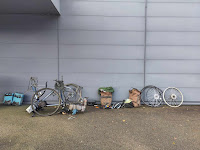
Coming from the bicycle another thing I suspect some readers might be interested in is which repair tools I carry with me. I will clarify some tools that might not be clear in the picture here above. From top left on, I have a rag and grease that I use for the saddle and for my shoes. It helps the last-named to fend off drops and the morning dew, but they will of course get wet in the rain. The three wrenches, of 8mm, 10mm and 15mm are the only ones you normally need on a bike (sometimes a 12, 13 or 14 is needed for the saddle or seat tube). They are complemented by the adjustable wrench. The rear sprocket key (next to degreaser can) is used in combination with the chainwip (self-made from wood and old chain, next to adjustable wrench) to dismount the sprocket. The degreaser is a very good bio-based one from Decathlon. It is itself quite fatty, but gets easily washed away with water taking most of the dirt away. I apply it with the toothbrush so to immediately remove the worst dirt particles off the chain. The grease in the tube is mostly for ball bearings, but I also use it as mounting paste for screws, so to prevent them from rusting or locking. The crank puller (next to the tube) is not super important, but it doesn't take up much space and can be useful when I want to replace a broke crank or clean the front gears. Under the tube is my chain opener. This is of course necessary when replacing a chain. Although with quick-links you could also use the specialised set of pliers, that I don't have, I think a chain opener is more versatile. I carry no spare inner tube, as most of the time the flat tires come from a sharp object. Then only a inner tube patch is needed to cover up the hole, which takes up way less space and costs much less. Another tool I appreciate a lot is the chain wear measurer, next to my screwdriver set. It can show if the chain is worn for 50, 75 or 100% and indicates thus exactly when to replace it, preventing excessive wear on the front and rear sprocket. Also, gloves might seem like a luxury, but often having little water at my disposal or having to look for another thing in my bags, I am very grateful for keeping my hands relatively clean. The tape, sand paper and zip ties are general tools I often end up applying on different things, they weigh a little and should be taken along in any case. The little fastening pincers are also quite general in their use, but I discovered that they are an excellent tool to accurately measure the wobble of the wheel rim, when truing a wheel. Very handy! Something not shown in the picture, but of course indispensable is a little bike pump!

Bicycle bags

Handle bar configuration:
Front pannier, tube bag and grey
 bag containing
my camping mattress (see below)
I carry most of my stuff in four Ortlieb bags. The two light brown ones are more than 10 years old! Ortlieb really lives up to its name of durability, and  even though other brands make decent bags as well (Decathlon, Vaude), I think my experiences show that Ortlieb really is the brand to go for. The old ones are kind of loosing their waterproofness, and that's why I put that orange raincover over them, even though I have remarked that some water also gets in from the underside, but so far nothing I really worry about. The little blue bags are brand new, bought them secondhand from a lady that didn't like the colours, for half the price. A huge steal! Combined with these bags, I have an Ortlieb front pannier that hangs on my handlebars that contains item I want quick acces too, like beanie, gloves, sunglasses,... this bag is completely water-proof and super handy with a magnetic closing mechanism. It is really an upgrade to consider if ever bikepacking. It even has a see through part, where you could put a map or phone to guide the way. I used it when entering Paris and having to follow the gps closely. A little handy decathlon back is hanging on my upper frame tube and around steering pen, it contains more items that have to be ready at hand, like multitool, pump and cutlery. Lastly I have a little saddle bag, that contains the orange raincover and a bag that I cover my leather saddle with when it's raining and I'm not sitting on it.

Cooking system (rabbit hole warning!)


After initially going on adventures with a gas stove and for a long travel experimenting with a petroleum (multifuel) stove, I became interested in alcohol stoves. I dislike gas stoves as they function on an expensive, fossil fuel, that also has this very bulky gas cans, that apparently are hard to recycle and cannot just be thrown away in the general trash or metal recycling bin. Multifuel stoves are very efficient (it vaporizes the fuel before burning it, so the flame is very clean), but I was disappointed to learn that the only fuels that don't damage the system are white gas (very pure but very expensive and hard to get by) and petroleum, something that is a bit expensive and also sometimes not widely available. It is nice that in emergency you can use the stove with gasoline or diesel, but I don't feel comfortable with it, as gasoline literally corrodes your plastic and aluminum parts and diesel tends to clog the tubes. Let's also not forget that all of these are fossil fuels with serious environmental hazards. It made me turn to burning alcohol as a fuel source. It is often made of organic waste from other industries and thus is quite renewable. The general downsides here are that it has a less high density in calories, so it cooks slower using up a bigger volume of fuel. This is not really a problem unless you're in a hurry. I don't mind; I like to do other things like setting or folding up the tent while the stove is cooking water.  The same goes for the volume, which is not bothersome while bikepacking. I even tend to pick up a 500ml soda bottle from the side of the road to get rid of the 1l bottle when it is half empty. Another problem is that is burns quite soothy, but I found out that it depends on the brand of alcohol and also how close the pan is to the flame (which reduces the sooth, somehow). Alcohol also becomes harder to ignite in colder temperatures, but there is nothing that a good lighter or matches can't do. I also think of the problem of having to pour the alcohol in the burner, so you can only estimate how much you need. I became quite good at assessing that amount, plus if you overshoot in the evening you can snuff out the flame and burn the rest in the morning if you cover up the burner. If during cooking you fall short on alcohol, you simply refill and ignite again of course. So most of the downsides are not really big problems that in my opinion don't add up to the versatility, sturdiness (no moving parts!) and cheapness of an alcohol stove. A secret plus side is that you can use that alcohol as a disinfectant, for example after you have gone to the toilet.
I tried to cook with a self made one (look up "soda can stove"), but was not satisfied with how fragile it was and the lack of good windscreen or system to hold up pans. I found a Trangia cooking system secondhand in 2023 and immediately fell in love with it. It is a brand originally developed by the Swedish army to provide it's soldiers with warm dishes even in harsh Scandinavian winter, which I think is a cool history! The very efficient windscreen that also house two pans and can even fit the tea pot (which I found in our basement funnily enough) or an extra pan, is a very cool design (very minimalist as well!). It also holds the pots really close to the flame, so I actually don't get a mess. I also like the cutting-board/strainer system. All to say is that after a couple of years of searching and experimenting, I will rarely use another system again.

General tools


A quick word about my most important "general" tools. The most important one is my Leatherman multitool. It contains besides that superb set of pliers, different screwdrivers, a saw, file, awl (to make holes) and two blades. I use it in very different scenario's and I like the sturdy build. Leatherman also offers a lifetime warranty, which is nice. I actually contacted them a few years ago, having a piece broken off on the Leatherman my mom had. They immediately offered to replace the tool with a refurbished one (the one I carry right now), just to say that they live by their promises. My foldable cutlery (brand is Sigg, but there are many) is also very handy, especially the knife and the spoon that I use for every meal. They are very minimal and easy to clean, so I expect them to last a lifetime. Last but not least is the little Victorinox SD, which although is meant as a manicure tool, has a super useful pair of scissors and a very handy little knife. I can really recommend having such a thing on your chainring. 
Planning my route down the Cotentin
peninsula and the map in the etui
Also an important tool is clearly my map etui, which holds my Michelin maps. Waterproof and handily hanging across my shoulder it enables me to always know where I am and where to go. I can clearly recommend navigating this way, as the maps shows points of interest. This and the ability to generally overview a broad area gives a lot of flexibility. I often only decide how to ride in the morning or even at a junction and even then can adapt. Compared to mindlessly following the suggestions of an algorithm (and not deciding for yourself what you want to see) or planning everything up front, it is a very relaxed system.

Camping equipment

I chose as my sleeping bag the "Makalu Light 3 down". It is from the Decathlon Simond brand and costs 300€. For a winter sleeping bag that has a comfoirt temperature at -10°C that is a very low price. So far it has been too warm to sleep in it with the zipper fully closed, so it's very promising for the colder temperatures of the coming months. I might invest in a more expensive sleeping bag in the future, but so far I'm really happy with it. The only problem with winter sleeping bags is that they are so bulky and a bit more fragile. It takes up more than half of one of my rear bike bags, and I am constantly worried I might compact the down too much, it is next to my bicycle the piece of equipment that I stress the most about. Accompanied is a small liner bag of polyester (not silk), I use it mainly as a way to keep the sleeping bag clean. Together with the sleeping pad it is also a Decathlon product. I have the insulated foldable pad from Decathlon because I was tired of every inflatable pad eventually becoming punctured after a not even a year of use. I prefer the lower comfort of a sleeping pad to waking up in the middle of the night, feeling the ground completely underneath you through the deflated mattress. I solved the bulkiness of the foam pad by hanging it from my handlebars protected in a custom made bag (merci maman! :))
The new tent!
I have always used tents made by Quecha/Forclaz (Decathlon). With Nicolaas I started out with their tunnel trekking tent. It is a very durable model, the one I had has been used since 2018 and is holding out just fine! As we split up in L'impasse du Mage, he returned with that tent and I bought the dome tent from the same Decathlon series from Guillaume. So far i'm really happy with it. It offers much more space, both for the luggage, since it has two storage rooms and offers room inside for myself to sit up in. It is a bit more long to set up and break down and packs less easily, but I find that the comfort is really worth it. I also think that, even though it is a few hundred grams heavier than the tunnel tent, it is more versatile. Since the outer shell can be separately packed easily from the inner tent, it can be shared between people when for example hiking. Another huge upside is that it can stand on itself, and doesn't need the tension from pickets. The design of some details is also nice, with the zip taking the outer flap along when opening up, so that you don't have to deal with a wet sheet that hangs in the way when getting out in the morning. Also a few hooks in the ceiling, enable you to dry a few things during the night. Lastly I also brought a tarp (from Decathlon), that I use to cover my bike with when the night is rainy (as too much rain is not good for a bicycle). It is a very versatile piece of equipment, I can use it to create a temporary shield against rain, for example when cooking or eating or in case of very heavy rain to protect my tent itself. It can even serve as a back-up tent in case of emergency.

Electronics

I don't carry that many electronic items right now, but I know that they can add up quickly. I have a headlight,  an e-reader being a secondhand bought Kindle, my smartphone (a Fairphone 4, please check out this amazing brand) and my laptop (macbook air). I also took little cabled earphones, with a usb-c connecting dongle. To charge everything up, I took two powerbanks with me. And old one from decathlon that used to have a capacity of 10 000 mAh and a secondhand bought Anker of 20 000 mAh, that is still very powerful. They so far give me at least autonomy for a week, but I probably could hold out longer if I didn't use my phone to record my routes and as a hotspot for my laptop. The latter can actually also serve as a back-up powerbank. I used to take solar panels with me, or dreamt to install a dynamo powered charging system on my bike, but I realised that it's rarely really useful. It's much cheaper and simpeler to just ask people on the way or stop in bars to charge up. Only in very remote places and with a lot of devices like drones and cameras does it seem useful to me

Clothing

A lof of clothes I carry are pretty straightforward, like socks, t-shirts and underwear. I have enough of them to hold out for a few days at least. I bike with one pair of pants, that I until now have carried like shorts; it's one of those trekking pants with legs that can be removed with a zipper. It's a decathlon model and I like it because it is light and dries really quickly, yet at the same time is super sturdy. I feel that pants like this don't have to be washed often, as long as you change the underwear enough. I have a set of thermic clothing, consisting of a turtleneck and tight pants in a very smooth fabric. I mostly wear the turtleneck now together with my blue fleece sweater. They work really well together to keep me warm in this cold weather and at the same time remove excess heat from efforts (like climbing a hill). When stopping I often put on my last layer, consisting of my shell jacket of Patagonia '(Torrentshell), that I bought in Paris. It also is my protection against rain and strong wind. After one month it still holds up pretty well, but I should wash it soon to restore all its water-resistant properties. I like the simplicity and lightness of the jacket. A luxury I allowed myself to take along is a pair of what I call "civilian" clothes, consisting of a normal pair of pants and a comfy woollen sweater, that I can carry when not cycling, for example when exploring a city or staying at a place. It also sooo nice to put them on after a shower when getting hosted in a house, it just feels more cosy than putting back on the cycling clothes. They take up quite a lof of volume, but they proved to be very useful, especially when staying for three weeks in L'impasse du Mage and giving the opportunity to change clothes enough.
I have low-cut hiking shoes (from decathlon), that are quite comfy and sturdy. They don't dry as quickly as I want to, but they also take a longer time to get completely soaked in the rain. I have flat feet, so it is nice to have good shoes I can put my orthopaedic soles in. In general I feel that shoes are not that important and that you can bikepack with any shoes you like, as long as they are comfortable for you.
For cold weather I took along a beanie (that fits under my helmet), a buff (perfect for cycling), and two layers of gloves. My silk undergloves have worked really well up till now, just fending of the wind, as to keep my hands warm. But in the last days, temperatures have dropped even further, soon will be the first sub-zero night, and it is time for the big gloves (that were special Shimano Gore-Tex cycling gloves). Unfortunately I managed to loose one of them in the last days, but at the same time they were a bit too small for me (I have no idea why I didn't notice when packing). I thus bought good woollen ones in... yes, a Decathlon. They are really nice and will probably take me through the biggest colds, especially if used together with the undergloves, ... as long as I don't loose them of course. I have also little cycling gloves for when my hands get painful, but so far I almost didn't wear them. Last items on the list are a visibility jacket, a pair of swimming trunks, a trekking towel (one of those that dries quickly) and last but not least a helmet. I want to stress that piece of equipment, because I've seen so many bikepackers without helmets and even though I understand the amazing feeling of the wind in your hair, unconstricted by that polystyrene box, it is so vital for your safety. I admit that when commuting in town, I don't wear one. I should, but then a helmet is not practical for when stopping and having to carry it along and also there is this sensitive question of pride and vanity of not wanting to look like a fool (not helped by the fact that very little people in Belgium carry helmets in town). But out on the roads, your time on a bike increases dramatically and also your chances of falling or having an accident. It can happen in many scenarios, like Nicolaas who fell in the Ardennes because of a slippery wet stretch of downhill tarmac. That's when a helmet is crucial and life-saving. When working as a cargo bike courier in Antwerp, I fell once in similar conditions, landed on my back and smacked with the back of my head on the ground. Luckily I was wearing a helmet and didn't hurt myself. But I felt the violence of the impact and I don't want to imagine what it would have been without that protection. I can add that a helmet offers also a few plus sides. It works really well to keep rain out of your vision and also gives shade against bright sunlight. I put some extra high-visibility tape on it, so I am even more safe at night.

Miscellaneous

Different not very connected pieces of gear that I want to review quickly are a thermos bottle that I fill in the morning and make tea in at noon. Drinking something something warm in cold weather is very good for the digestion of food, an Alpine guide once told me. I have also a big camelback-style water container of 5 liters; not useful in France, but it's good to have it in case of emergency or when cycling in drier places like Turkey or Morocco. In tandem with it I brought a water filter, that I so far haven't used, but might be soon. I also have a special gadget consisting of a rubber mesh with metal parts that can be put under the shoe, and which enhances grip on ice and snow. I imagined myself having to push the bike up a snowy and icy hill and took it along (it was a birthday present from a while ago). It's probably one of the least useful, but bulky things I carry. I'll see if I keep them or not after Christmas. 
I further took along —naturally— a medical kit, which contains many different things, like different medicines, bandages, disinfectant and even a handy little sowing kit. 
Also a quick word about toothbrushes and toothpaste. It's more a call to stop wasting plastics than really a primordial thing for when trekking. I have one of those toothbrushes where only a small head needs to be replaced and where the handle is continually used. During an earlier trek half of the handle broke off, but I simply connected half of a bamboo toothbrush handle with a screw onto it, and now I have probably one of the coolest toothbrushes out there. I find extra heads in waste- and package-free shops in larger cities. The toothpaste is also very interesting: I have "Dent tabs" with me, that are small pills of toothpaste that just begin foaming like the regular one if chewed on a little. They are often bought in bulk in the same kind of shops, and even a handful can last you for weeks and weeks, as they are very small. They contain fluoride, so it's as healthy for your teeth as the regular brands. As with many products, a lot of brands sell you partly just water, and denttabs are a nice way of circumventing that rip-off, tackling a big problem of plastic tubes along the way. When on a short trek you can even count how many pills you should take along and reduce weight and volume to a minimum! I've been using them every day for a few years now and it feels as natural as any other thing of my daily routine.
Another thing I would like to mention about hygiene is that for more than one and half years I have stopped using shampoo or soap to wash myself. I simply rinse myself off with (preferably) warm water. I scrub a little extra on the parts that accumulate more sweat, like armpits, arms or pubic area and I take time to massage my hairs well, and so far I've been doing just fine. I received no complaints of smelliness (what I was most afraid of) and no special skin disease has appeared. My hair is a bit more fatty than when washing it regularly with shampoo, but it is actually hard to notice. I have some periods with dandruff, but that happend in my "shampoo-life" too. The reason I decided to stop with this products is first of all the realisation that many shampoos and shower gels are not very good for environment and climate. Even though more nature-friendly alternatives exist, the fact that I don't really need them, made me persevere. I also feel now (and this is not really backed up by science whatsoever) that my skin and skin bacteria are good at regulating themselves and I don't need to remove them with soap every time I wash myself. Now when trekking and only having the opportunity to wash once in a while, I consider this decision as a huge win: I don't really feel that dirty, compared to a few years ago when I stopped every night in a camping to be able to take a shower. A drawback to this, is that in general I avoid swimming pools whose water contains chlorine. It is essentially the same as any soapy product and after a splash last year, I could feel how my hair was completely dry again. You need to go though a period of quite greasy hair when stopping with shampoo and I had to go through that phase again after the visit to that swimming pool. In general I don't judge people at all for using soap and shampoo, maybe I'm just lucky with a body that is regulating itself well, but I hope I've managed to inspire a few to just test it out for themselves... 


donderdag 28 november 2024

Long blog: my journey with Nicolaas in France and stay at L'impasse du Mage


L'impasse du Mage upon arrival
So where am I? What have I been doing? A conclusion is that sometimes other projects come before the blog. Normally this would really bug me out like managing a thesis with a job or other projects, but I decided to simply enjoy my time and put energy in the things that I intuitively wanted to put energy in. Having mostly time to write in the evening when I was tired simply made the blog lag a bit behind. I originally wanted to cover only the part going to Paris, but it feels more logical to write about my whole experience in France so far.  It will mean though that I want to write about what happened during one month, not an easy task. Another reason write about the whole journey so far is the fact that my travel has passed a significant turning point: Nicolaas has returned home. I will continue solo. More about why Nicolaas left and what that means for me later on. So, where have I been? I've been residing in l'Impasse du Mage, in a subregion of Normandy that is called the Norman Switzerland. Contrary to the rest of the area with quite flat plateaus, here the Orne river and smaller streams have carved a very steep landscape that is characterised by a lush bocage, something that we already saw in Voeren and the border with France. Some valleys show big, beautiful cliffs (e.g. Roche d'Oëtre) and nature is quite well conserved. We are staying with Alice and Guillaume, their two children, Victor and Margaux and their cat Mazet. They live in an old countryhouse, that they bought as a quasi-ruin. They are spending their time between raising the children, renovating the house and terrain, one hectare!, and their very ambitious jobs.
Guillaume is interested in decentralising the internet and is organising the construction of (ecosystems of) internet tools, in the form of data-spaces, for local communities to help them organise themselves, hasten the ecological transition and facilitate communication between their own different digital environments. Alice is a programmer and works freelance with a small activist collective. Staying almost three weeks in L'impasse du Mage was necessary in the way that it enabled to really exchange with them. In local circles they are regarded as interested and motivated people, with many contacts, new ideas and lots of energy to try lots of things. Alice among other things created an eco-sciencefiction festival around the future of the Bocage landscape (so cool), but at the same time she participates (or will be) in local politics, handles a local newsletter, puts effort in a local mental health initiative, and helps organising a militant activist festival, called Les Résistantes and that will happen next summer in the neighborhood. I sensed through them that even one of the quietest regions of France can be active and full of people ready to build a future together and try new ways of living even without living in a closed community. They offered me many opportunities to meet these people, like a baker who grows his own bio-wheat, the local left-wing opposition party, participants of Alice's science fiction festival, a student who is doing her civil service on strengthening relations between (ecological) farmers and communities, a regenerative farmer, a biologist who monitors the mammals in the area, owners of a hostel with a ecological focus, activists organising the festival, an entrepreneur who own a company that extracts biomass from the bocage hedges, a entrepeneur building a ecosystem of information tools for farmers to handle their business, the mayor who hid a wanted leftwing terrorist in the past, the local bicycle manufacturer and even a couple who on principle has decided to not work and live on social security, but nonetheless do a lot of voluntary work and try to live in autarky. I met as many interesting people in two weeks as I did in months when living in Belgium, the same counts for discussions an new ideas. I also got plenty ideas for the next few stops, mostly in Bretagne and the Southwest of France.
Every season has passed it seems...
No electrictiy so the mass stove and
candles provided warmth and light.
Staying here, I experienced the last warm days of 2024 and the first snow. We got a big snow storm, that left us without internet and electricity for a day (other villages even for days!). Luckily the gas stove for cooking and the super interesting "mass wood stove" still function. The latter is a huge two ton system that enables to warm a well isolated house for two days, after burning about 15kg of wood. It is capable of extracting almost all the calories burned in the fire, so the smokes comes quite cool out of the chimney and the burn is super efficient (hot!) and releases only CO2 and almost no other nasty particles (like sooth, or carbon monoxide). Because the wood is abundant and circularly extracted from the hedges, it counts as a quite carbon neutral energy system, although it is mostly applicable on the countryside and not in cities. It has also a high cosiness factor, which should not be neglected.
Nicolaas and I clearing the field
I was invited to peoples houses, got the local aperitif, pommeau (calvados mixed with fresh apple juice and rested for two years in oak barrels, suuuuuper nice) after helping out the baker clearing a field of branches and a neighbour took me for a morning run in the deep snow. It is difficult to explain the warmth emanating from this world, but I find myself to be extremely lucky being here and I feel grateful for that, even though so far I did not cycle as much as I had planned originally.


working...
During my stay I helped Alice and Guillaume with a lot of things, like renovating the house, working in the garden and generally in managing the household, taking care of the children. Nicolaas stayed one week and together we did quite a lot. We covered a big part of their attic ceiling, transplanted a few plants in their garden and started to work on a chicken coop. We also rested quite a bit, took a bit care of the children and explored the region. Especially the Rocher d'Oëtre, the local natural monument is really beautiful. Nicolaas, who is allergic to cats, particularly suffered from our stay here and it was one of the reasons he accelerated his departure, leaving after one week and half. In the last days, we talked much less and almost exclusively in french, Nicolaas wanting to improve his speech. We were so occupied by the children, Alice and Guillaume, or working that we fell back on the comfort of each others presence.
... and enjoying the area
Once Nicolaas left, besides becoming stuck in the snowstorm, I finished the chicken coop (in the night before leaving as it was more work than expected and the soil here is full of big rocks), helping out the mayor's brother sawing some wood for a construction project, and participating in the meeting about the activist festival. I also had been working on a personal project of creating my own sandals, having lost my flip flops on the first day cycling to Aalst. I became stuck on the idea of making sandals out of trash and more particularly used car tires. The big workshop offered all the tools I needed to construct them, using my time off. I am quite satisfied with the result, having made sturdy shoes out of a salvaged car tire and plastic bags. They look cool, being quite eccentric (a character trait of mine I have embraced). It will be useful in case my shoes are very wet or to walk around indoors.
I discovered that the local community is really divided about the advent of this very left-wing event, as the area is politically dominated by right-wing authority, some fearing the disruption with moderate leftwing alliances or the deputies cutting grants to certain associations linked to the festival. I witnessed some debates and also at home it was a big discussion. The meeting was interesting, because I heard the voice of some of the organizers. Les Résistantes is definitely something I'll keep an eye on.
During the stay I think I also managed to really find a place at this home. I grew attached to the children, who are still small and who often need a lot of attention and I almost played an au-pair role. I helped tidying up and cooking, which made it easier to accept the fact that I was staying for free, relying on their exceptional hospitality. I think an intuitive "click" made me stay so long at L'impasse du Mage. I will definitely try to come back here or invite them to stay in Belgium!
So how did find this place? Once again we followed up on a thing Nicolaas knew of, called "Les Chemins de la Transition". We had already explored the website before departure in October and it was one of the reasons I became convinced that going on this kind of trip with Nicolaas was a better plan than racing solo to Morocco. When in Paris discussing where to go next, we looked at the map and decided to go to the project of L'Impasse du Mage he had already envisaged in September. Guillaume gave us almost immediately the green light and the decision was made. When arriving we discovered that he was the creator of Les Chemins de la Transition, which we thought was an incredible coincidence, considering the many available projects (especially in Normandy). Being also an ongoing project of his, it tries to create certain thematised parcours in France (chemins) that lead its explorers across many different projects, like ecological farming, circular economy, certain arts and crafts. It is meant as some kind of alternative to the Compostella route (Chemins de Compostelle in french), with an accent on the experience and knowledge that those place can offer. It comes along with a blog system (I wish I knew it earlier) and a forum to see the other participants experiences. If you ever fall short of travel ideas, here is a perfect one I can recommend.
Looking back at my stay and travel, two things are clear in this light: there are so many projects of well-meaning people scattered across France and Belgium, available through platforms like wwoof, workaway or les chemins de la transition. And secondly I feel much more hopeful about the will of many people to enact change today, a hope that I wish to also convey upon the readers of this blog. 
Let me now tell about how we arrived at L'Impasse du Mage.
First some bocage, soon replaced by big open fields
misty weather forcing out
the fluo colours
Considering the terrible flooding back then in Spain, Nicolaas and I cycled rain-free to Paris from the 27 October to 1st November and to the Impasse du Mage in Normandy from the 5th to the 8th afterwards. We only complained about misty, humid mornings, which often forced us to wear our yellow vests, making us more visible, but at the same time being a potentially dangerous political statement in France. The dry weather did not prompt us to look for accommodation whatsoever. This made arriving in Paris at my uncle's place the first "shelter" since leaving my godmother's (although "shelter" is an almost insulting term for their comfy apartment in central Paris). It also meant that we truly spent a week and a half outdoors mostly cycling, bivouacking, eating and looking for food, either around us or in the sparse bakeries and supermarkets.
Mud on the road getting stuck
between my mudguard and
tire, frustrating 
It was interesting to experience the weather changes in this time of year, as we had the famous warm 26th of October (see previous blogpost) and ended up constantly wearing gloves and jackets while arriving in Paris. Some people we met along the way remarked that we were cycling to the "South", but that of course was not nearly far enough to escape the inevitable cold of the impending European winter. I knew then that in my next few weeks of cycling I should be ready for colder temperatures, which has some inconveniences, but so far I didn't experience anything to really worry about. I mostly got frustrated by the mud mixed with leaves getting trapped between fender and tire, something that was difficult to remove and acted as a constant brake. For the people interested: yes, we also did not shower or wash for that period, something that I expect will make some readers wonder how I'm possibly still alive and well. (Also that shower in Paris felt amazingly good).

one of the rare bakeries and us trying out
interesting new spreads on the baguettes
The north of France is typical for a mostly agrarian region with a crumbled industrial past. A lot of empty, silent villages made with crude, cement and brick-houses, industrial agriculture with big dairy farms or neverending monoculture fields. The valley sides make up for the green forests, the areas no one has been able to utilise. It definitely had an impact on us, how wide and alienating, but it was always a pleasure climbing or descending through woods and greens. Our route led us through one beautiful city, Laon, a medieval town perched on a steep hill (it dominated the lower fields towards the North, where we came from). The cathedral is a masterpiece, showing statues of exotic animals like a hippopotamus. The rest of the city is in a bad shape, but we had a nice talk with people from the local anarchist group, who were keeping an anarchist book shop and a soon-to-be-opened library.
Arriving at Laon
American cemetery of Bois Belleau 
After Laon, we entered more and more the territory of the First World War, with the impressive Chemin des Dames (a road on a ridge were heavy battles were fought), and the 1918 German offensive through the Marne valley. It powdered the area with different military cemeteries, some of which were very interesting. We visited an Italian one, which taught me about Italy also fighting (in small numbers) on the Western front, and not only on the Italian Front. Another one we took time to visit, was an American one, of which there are only eight in France from the Great War. It was as if entering the USA itself, with neatly tended lawns, and a broad road to acces it. When I talk about something that feels like the United States, I imply it's the great 20th century image we Europeans have of it, not the country like it is since the recent elections won by a certain convicted felon. Entering the cemetery emanated an exaggerated ceremonial vibe, especially with a huge, tower-like chapel in white stone, but it was still quite impressive in the end. German cemeteries were typically very sober. Mostly grey stones with four names, they still held something strangely beautiful, healing, conciliatory. 
We also passed the westernmost corner of the Champagne (Charly-sur-Marne), with endless vineyards. As we had fixed a certain date to arrive, we kind of realised that, in a straight line, we were going to arrive too soon, so we rather took our time, and cycled an L-shape to arrive in Paris. In a little village I even found time to clean the bicycle chains once again (which would get inevitably spoiled the next day when cycling through muddy forest paths). That way we took our time, which also generated opportunities. Nicolaas was able to crack open an immense mass of walnuts and staying that long in a village square let us see that a seemingly dead village was quite alive. A pensioned archeologist who passed by even gave us a quick guided tour along the church, pointing out details I would have never seen (like a mysterious stairway on the outside wall).
Leaving a bivouac spot in the morning
It illustrates the nicer moments we had, as we did have our fiercest arguments on that leg of the trip, which often had a rather negative impact on the mood. It could be for example a purely philosophical discussion on politics or rather an argument on which camping spot to select. Looking back on it after a few weeks, I see our respective desires to be right mostly as the reason of many clashes. I'm not saying we're two pedantic figures, but this good qualities of wanting to "Nuance" or being "Truthful" can really work backwards on two people with this kind of persona. It didn't help as well that we had very different energy levels, me often wanting to continue and Nicolaas already being weary. I often felt frustrated because of this kinds of differences, but managed to let that frustration evaporate gradually. I was quite self-aware and tried to analyse where the anger or irritation came from and every time discovered it came from childish or stubborn parts of myself, which helped to make all of those feelings dissolve. I also think that this is the normal effect of travelling in duo and being constantly in each others presence. I experienced easier travelling companions, but overall I am very happy of having travelled with Nicolaas. It was also going to Paris that Nicolaas announced that he would return home before december. We agreed on visiting the capital and one more project together but that he would leave afterwards. I felt both excited that I would be able to explore France on my own and at my own pace, but at the same time it kind of removed a structure that helped me support the travel. Luckily I had time to come up with new plans and ideas for the last part of the journey before Christmas. (I now have a little less than a month of cycling in front of me. I want to be in Grenoble by then to celebrate with my family and I have plenty of plans!)
the famous muddy roads near Paris
On our last day we even chilled in a cafe for an afternoon, writing and reading. The unfortunate muddy roads we took afterwards slowed us down and eventually made us cycle on Halloween through some dark forests (that were enclosed with fences so that we couldn't bivouac there), this way we actually participated in this strange Western tradition of celebrating fear together once a year. We ended up sleeping in a mountainbike training zone, but we had an excellent rest. The next day led us into the heart of Paris, very slowly through the huge suburbs and cités. I chose on purpose a route that wasn't easy like a greenway next to the Seine. I wanted to cycle through the city and see the buildings and people that you normally never see when arriving in Paris. It was intense with some very unpractical cycling lanes, (I probably should be grateful that they even exist), but we actually progressed swiftly!
Entering Paris felt like a dystopia of industrial worlds and tall apartment buildings
As kind of foreshadowed; we already knew leaving the Elzéard Foundation that the next big stop would be Paris. In our view (not very deeply discusses to be honest), we imagined that visiting a green cooperative and a rewilding project (not to mention the green lifestyle of my godmother!) already kind of covered the more "nature" aspect exploration.

Arrived in the heart of Montparnasse!
Another kind of project that really fascinated us was squatting, or the occupation of abandoned or unoccupied area's. Nicolaas had already visited some squats in Dijon and in the Pyrenees. The idea of a community that establishes itself and tries to exist in a restricted and temporary context impressed me a lot. We hoped to encounter people there with interesting ideas. We even thought about offering some help if possible. We used a platform to find public squats (i.e. squats that announce themself publicly, that are known by authorities) that even had a nice little calendar for events. Paris itself doesn't have that many true squats. There is for example the 59 Rivoli, a legalised one in the heart of the city center, but it is more a gallery and resident for artists. The periphery of the city has a lot of them, like in Montreuil. As we only had four nights in the city, we decided to concentrate only one day of the three we had on the squats. We wanted to also see a museum and Nicolaas had a friend to pay a visit to. 
So on Sunday we went to La Kunda, a squat in Vitry-sur-Seine, a bit out of the city. Residing in an old child care center, it houses about 70 people!  It is also very much focused on working with the neighbourhood, like distributing the leftovers from local supermarkets and hosting a fitness and boxing club. They received their eviction order, that could be enacted from next April onwards, what prompted them to open up a bit more to foster more support from residents all around. They had some kind of lunch buffet at a free price, distributed vegetable leftovers and organised a boxing initiation in the afternoon. I had the opportunity to speak with some of the older members of the squad and they explained some of the inner workings of this place. The squat struck me as a place that is in a way sealed off of the regulated, strict outside world, but still manages to maintain order and cohesion, albeit from a much more horizontal way of organisation. It is a place for those that think outside of the box or want to live (or experiment) according to their own rules. We decided to partake in the boxing lesson, a sport I had never tried before and I actually liked the atmosphere of respect and self-control. It definitely helped to connect a bit more with the squat residents. We did not feel comfortable taking pictures of places and people who are so at the margins of what is legal, so we have only this cut-out of me at the boxing initiation. 
We also met an interesting girl who was visiting as well and worked for an association encouraging community-supported agriculture and also knew someone who was bikepacking as well. Weird how in a random squat in Paris, we could meet such pleasant, similarly minded people. Another event on the radar squat website pulled us to a small gathering of poster activists, who made their own posters and went around town to hang them up guerilla-style. There we maybe encountered a more dark side of activism, the one that encourages paranoia and the tendency to reside in small bubbles. We did talk a lot about digital hygiene, like not giving away your information and made a poster that was meant to inspire people to act together (up to the reader to decode the text in the picture). Looking back I mostly remember the distinct, almost polar opposition between the vibes of La Kunda and this collective.
Casually drinking wine in front of the Picasso fresco at the UNESCO headquarters

On Monday we visited the city a bit more, but thanks to Nicolaas' friend who did her internship at the UNESCO headquarters, got a exclusive, amazing tour there. We were entered when an Arab World convention was taking place, so we briefly saw many different representatives, from generals to ambassadors. What a crazy luck we had. The rest of that day we strode across the heart of Paris (Eiffel Tower, Seine, Louvre; you know) and paid a visit to the Centre Pompidou, something I strangely had never visited. In the crowded exposition room I was particularly struck by three Francis Bacon paintings (an artist I take particular interest in) and the beautiful sunset over the Parisian skyline. 
That same night I also went to a cafe I wanted to go to for a long time. Having seen a Le Parisien documentary about it (here is a free to read article in french about it), I was determined to go. Nicolaas being tired of the day and having to cross the whole of inner Paris, I stayed until two, talking with the owner, Raymond and with another customer, Thierry, who told me about his crazy life and undertakings.
We left Paris the next day, me quite tired with my 5 hours of sleep and still getting the alcohol out of my system. I managed to forget my new Patagonia jacket I bought in a little Parisian store (my other jacket was becoming obsolete in terms of impermeability; and I donated it to the La Kunda owners, who where very happy about it) and map, so we had to wait for the reserve key storage to open. Time which I used to... yes, you guessed it right, clean the bicycle chains! We also spoke briefly with an interested passer-by who said a prayer for us, which I thought was very sweet. 
Versailles
From then on, we were off, and cycled in the same confusing, "secret underbelly"-way out of Paris. This time we passed close to the Versailles castle, which was very impressive, even seen from outside. We slept on a golf course in the ultimate outskirts of Paris, which was a very pleasant thing to do; such nice, well-watered and nurtured grass! The next morning we quickly broke camp at the sight of the first golfers, who approached our hole at 7:45. What a determination! The last few days before L'impasse du Mage we cycled through a rather monotonous landscape of very broad fields, but I managed to guide us through a few forests, where we found an awful lot chestnuts, which we cooked up in various ways over the successive dinners. The atmosphere between us was rather good, even though Nicolaas was often tired, as we cycled much bigger distances than before.


Collecting chestnuts, the first hedges (and more hedges)
 and the first tire puncture...
We had less arguments, maybe the idea that we had less to prove and that arriving in L'impasse du Mage was going to be our last time together made us more in balance. A very nice thing that on the penultimate day, we really experienced entering Normandy, as after crossing a forest the open fields were replaced by hedged and pastures. We truly were back in the Bocage, something that really made our day. We also slept between hedges that night, a great pleasure (compared to the little patch of trees we slept in the previous day). After the World War 1 area of the previous week, we this time arrived in the area of the Battle of Normandy, of the Second World War, with its own set of monuments and "lieux de memoires". Before arriving, we even picnicked at a prehistorical site, one of the best preserved fortresses of the late Bronze Age, with very impressive crumbled walls. We did a little hike around the site and wondered at the nature. Knowing this was the last part of a "cycle time", I was particularly relaxed and enjoyed very much the sight and plants. Now, almost leaving again, I can't wait to be back on my bike.


vrijdag 1 november 2024

Cycling the Ardennes

This blogpost is written for the period of 19-27 October. Cycling the Ardennes for that week and a halve was another eventful leg of the trip! After leaving the Elzéard foundation we cycled for three days, but stayed then three nights at my godmothers place. It was a last well-known stop before finally leaving the territory. 


Arriving in Liège, start of the Albert Canal


Golden hour in the morning,
 bivouac close to Liège 
On the first day cycling from Voeren, we stopped in Liège where Nicolaas and I spend our afternoon separately. 
He had his girlfriend paying him a visit, with whom he cycled leisurely through the Ourthe valley. I on the other hand went to see a cousin who is studying physiotherapy here. My mother had organised a big family reunion at the end of the summer. There we met a lot of family that I’d never seen before, and it was surprise to discover I had a French cousin living in Belgium. It felt good to continue establishing the new family bonds and we had a nice small lunch and visit in the surprisingly vivid city centre of Liège. Nicolaas’s girlfriend bivouacked with us that night, after we met up again near Esneux.

Komina sending us down a mud track
 between fields

She left the morning after having to go back to Ghent. Komina, the Komoot gps-voice, guided us through the hills between the Ourthe and the Meuse, with wooded valleys and green hilltops for two days. She did sometimes think we were rather mountain biking or being way too adventurous, because she sent us through a few muddy paths (very impractical with that much luggage and small tires), but overall the Komoot route was very good. Even though it was only the second time we consecutively cycled for a few days, this time we took less breaks and stopped less. The initial pleasure of being out on the road and looking out for and being excited by every detail had kind of faded away. Maybe the mindset of overcoming the distance and going from A to B, that is also more my own, had become more dominant. The absence of small pauzes still made us reach the limits of Nicolaas’s stamina, so we took a longer lunch break on Sunday before arriving at my godmother’s. We used the same system the following days, either longer breaks or an early stop in the evening. My advance-focused mind did also enjoy to relax this way, not move and just experience the watery sun appearing behing the clouds and warming my back, while writing and reading during lunch breaks. 


Chilling at the next camping spot

This is in a lot of ways the opposite of arriving somewhere to bivouac. Then it is routine and organisation that dominate my mind: unpack, cook, search for utensils and food, eat, putting up the tent, arranging stuff, putting stuff back in the bicycle bags; so many things to do. Having little with me, makes some processes longer, especially cooking. But at the same time, eating the food cooked on a little alcohol stove is one of those tasks that makes me proud of myself. We did our best to make nice food, like cooking eggs in the morning our making a nice pasta dish (with veggie meatballs!).


By now, most of my gear and stuff has it’s precise place in every of my six bags (I hereby promise a post about my gear will be made in the coming month). All in all, cycling long distance is a simple life, with simple pleasures and pains. The routines and focus are something that can support or constrict the travel experience and it is, as always, a question of balance between them. Nicolaas being such a different companion is part of why I am happy having him along, because he tends to break my habits and routines to create enough interesting and refreshing moments.

Doing the dirty work
of cleaning a chain
The cycling routine was pleasantly broken by the stop at my godmother. She lives in a beautiful village, Marcourt, with her wife Els, where she works almost fulltime in the garden and on the land, where a lot of trees are planted. A part of the land is used by another farmer to keep sheep in, which offers a nice view out of the living room.
  She is one of the most energetic people I know, always full of plans and ideas. I have made a tradition out of it, to always stay a night when I cycle south or north trough the Ardennes. This time, in the spirit of our travel objectives, I offered to help her out for a few days. This gave us the opportunity to work and rest a little bit more before the planned week of cycling that was coming up. The work was very fun and fulfilling: excavating an old tree stump, planting new trees, making firewood, transporting hay. My godmother had made a big to do list we only did about half of. On our last day, we also cleaned our bike chains (this has to be done once in a while to extend their lives). Furthermore, we ate very well, thanks to the cooking skills of Els, with for example a stew with lamb from the sheep outside. It didn’t felt wrong (sorry fellow vegetarian readers), as it truly came from next door and was from some good, personally observed farming. When we left, we had also replenished our luggage with olive oil, toilet paper and some rhubarb jam (delicious), crucial items when bivouacking. 


Always follow the little green-and-white cycling node signs... (also note the weather getting worse)

Back on the road felt good for us both, as we both longed for a longer part of just travelling by bike and not stopping. I had also discovered another website for cycling nodes, which has a more up-to-date map, that even showed areas where on the current day a hunt its taking place or where road works would force you to take a detour. The biggest surprise was that there were cycling nodes in France, which inspired me to program a huge route trough the Fagne-Famenne region and into France, purely by that node-system. I was curious for the quality and choice of roads. And wow, I really can recommend using them for Wallonia. The network is a little less dense, so going in a certain direction makes the route even more full of detours, than in Flanders. It also shows gaps, like under Liege and around Charleroi. The non-asphalted parts of the route are also much more soggy and muddy, but the landscape and views are all the more beautiful. You pass beautiful forested hills, picturesque villages and over small streams, you encounter ancient trees and weird sculptures. There is also a surprisingly big amount of cycling infrastructure. I will certainly use the cycling nodes in the future for the south of Belgium and if it extends even more, in France! 


Seeing the oldest linden tree of Belgium (400 years), Baraque de Conneux, and encountering strange artwork near Dinant

Leaving Marcourt, where we were always talking and working with our hosts, left Nicolaas and me on our own again, which meant we had to work together more, but also caused more friction at certain times. Besides the frequent discussions, our differences in strength, moments of tiredness or energy and just plain personality caused distance or collisions. We sure are both sensitive and like to be right. I for example tend to be a bit brisk sometimes, which for Nicolaas is something that is hard to handle. I on the other hand have difficulties taking critique, especially on decisions I make, which is tough, as I program the route, which involves lots of them. Generally we are trying to give each other space and we often talk about it afterwards, so no friction is left to ‘ferment’. It is interesting to consider how travelling with two makes possibly the most true personalities come out, with good and bad sides. I think the friction is very normal, and in general we really enjoy the travel together.


A big highlight of our past days of travel, in dry, (and thus) excellent weather conditions, was certainly the barrage d’Heure, where we arrived at lunch time. It was the warmest 26th October ever recorded in Belgium, and sure did we notice. We took a swim, sunbathed and I even took the opportunity to wash some clothes which dried well on the tree branches. I already knew then that it was probably the last of that exceptional warm, amazing weather, since we had grey clouds and morning mist ever since. I also managed to get my second vaccine shot against brain encephalitis (I got my first one before leaving) in Chimay, something I had to plan ahead for, calling different pharmacies. Finally I obtained it, and got the injection the same evening at the medical out-of-hours service. To celebrate we treated ourselves to Belgian fries (also to commemorate our last day in our Kingdom). The next day a RaVel (Réseau Autonome des Voies Lentes), some kind of Walloonian greenways laid out on old rail lines, lead us out of the country.

A misty border-crossing
We passed through a very underwhelming border crossing and into a very misty France. The cycling nodes there are nice, but we followed them  too little to really say something about them. From then on, I will mostly orient myself on the paper Michelin travel atlas of France, a kind of map I have been using since my first cycle journeys, where I rip out the pages that I need from the atlas. It works very well, as the map shows points of interest, beautiful roads, climbs, some altitudes and the size of the roads. It makes navigating along the calm and pretty roads of France easy. It also never needs to be charged and is hanging in a plastic etui around my neck: always available! We are headed to Paris in the coming days, a travel I will cover along with our probable stay in the Capital! Cheers and thanks for reading.


Our last cycling node sign. Into France!